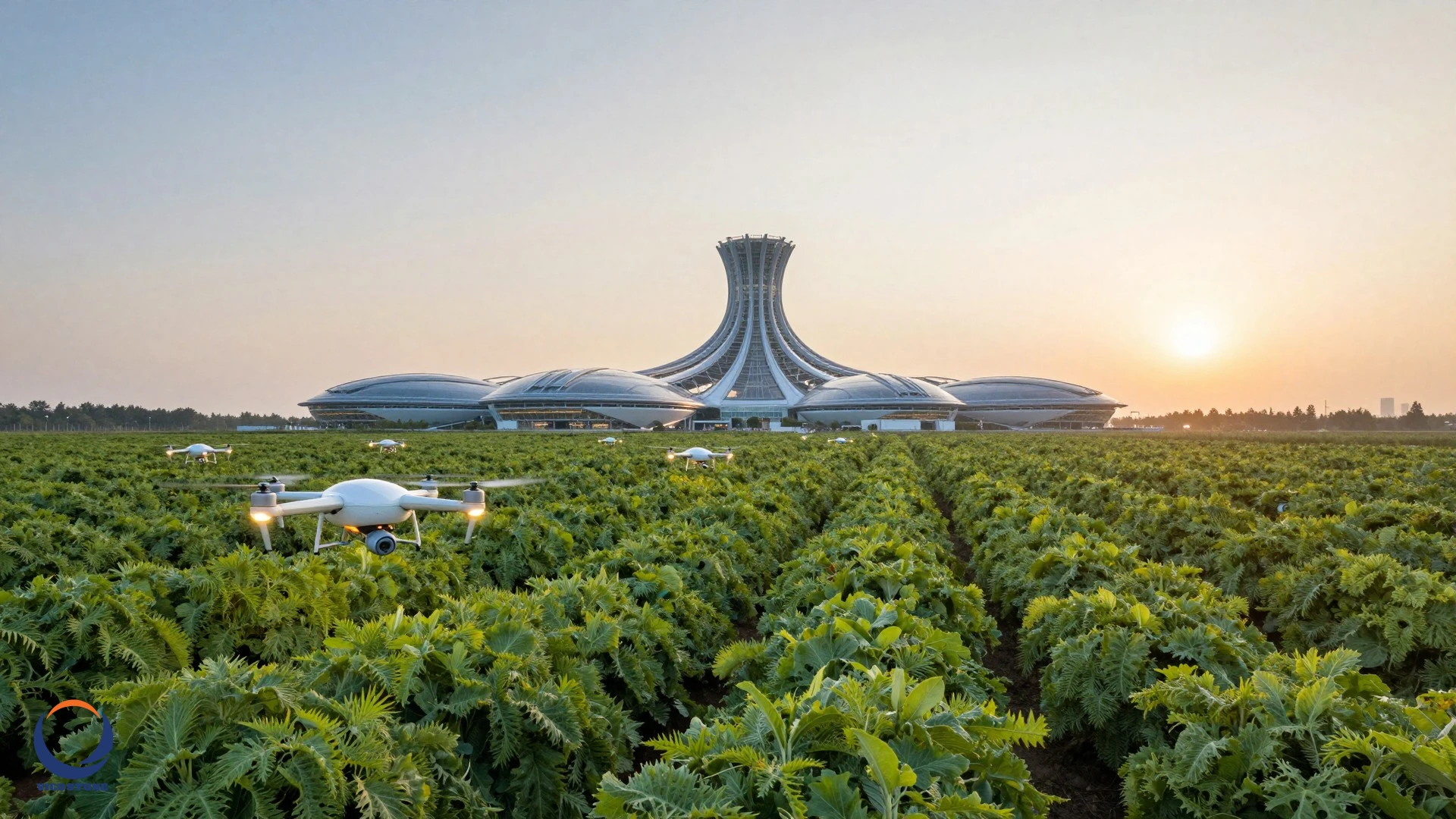
The global demand for food continues to escalate. Meanwhile, arable land and production resources are increasingly limited. In this critical context, artificial intelligence (AI) in agriculture emerges as a groundbreaking solution [1]. From monitoring crops with drones to precise weather forecasting and smart irrigation systems, AI is transforming the agricultural landscape. It helps optimize costs, boost productivity, and foster sustainable development [1]. This article explores how AI reshapes modern agricultural production and opens competitive opportunities for businesses in the digital age.
AI’s integration into farming practices marks a significant shift. It moves away from traditional, experience-based methods towards data-driven decisions. This evolution promises a more efficient and resilient food system for everyone.
Understanding AI in Agriculture
AI in agriculture involves applying artificial intelligence and related technologies to farming processes [1]. These technologies include Machine Learning, Computer Vision, the Internet of Things (IoT), and Big Data. The primary goal is to automate, optimize, and enhance efficiency across all stages of agricultural production [1]. This spans from planting and tending crops and livestock to managing land, forecasting weather, harvesting, and distributing products. Instead of relying solely on traditional knowledge, smart agriculture empowers farmers with accurate data and scientific predictions [1].
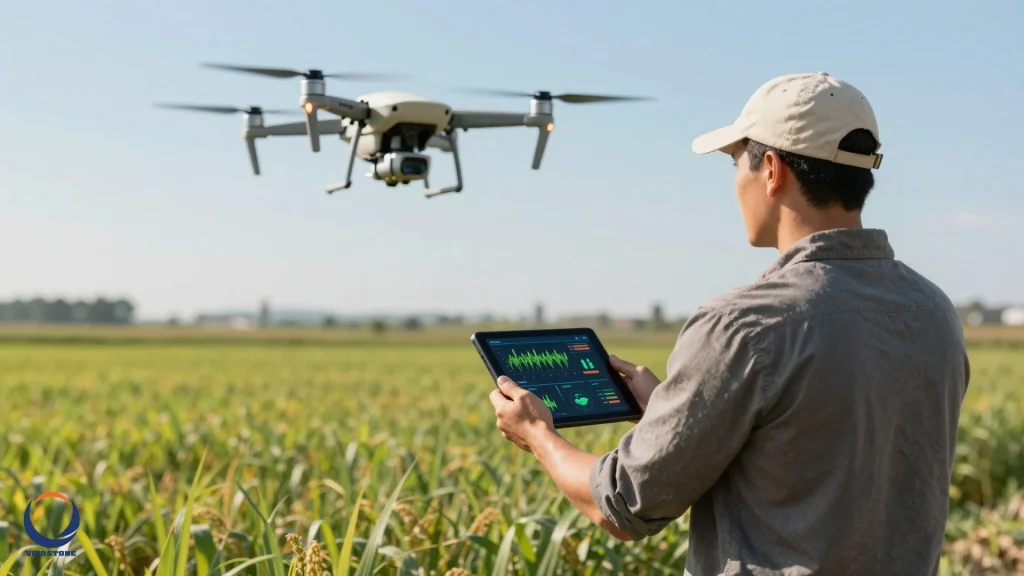
This data-driven approach helps optimize yields, reduce costs, and minimize risks in cultivation [1]. AI acts as the “brain” within smart agriculture systems [1]. It processes vast amounts of information from sensors, satellite imagery, and drones [1]. This provides crucial insights into soil moisture, nutrient levels, pest infestations, and weather patterns. Furthermore, AI systems automate farm machinery, such as planters, harvesters, and smart irrigation setups, reducing manual labor and increasing efficiency [1]. AI can also predict crop yields, disease outbreaks, and market fluctuations, allowing farmers to plan production and business proactively [1].
Why AI is Essential for Modern Farming
AI is not merely a trend; it represents a pivotal shift in agricultural production [3]. With a growing global population and finite land and resources, AI is seen as an indispensable solution for boosting productivity and sustainability [1]. It helps minimize production costs and optimize resource utilization [1]. Traditional farming methods, heavily reliant on experience and manual labor, often face limitations [5]. A lack of precise data and weak analytical capabilities can lead to subjective decision-making, resulting in wasted resources like water, fertilizers, and pesticides, and inconsistent yields [5].
AI offers a fundamentally different approach. It provides capabilities for learning, pattern recognition, problem-solving, and decision-making [5]. This technology processes vast amounts of Big Data collected from various sources [5]. These sources include field sensors measuring soil moisture, temperature, pH, and nutrient content, as well as satellite imagery for monitoring crop health [5]. This comprehensive data analysis enables farmers to make informed choices, leading to more efficient and sustainable practices. Therefore, AI is crucial for addressing contemporary agricultural challenges.
AI versus traditional farming methods
The contrast between AI-driven agriculture and traditional methods highlights AI’s transformative power [3]. AI integrates modern technologies like sensors, big data, and robotics [3]. Conversely, traditional farming relies on practical experience, manual labor, and direct observation [3]. AI significantly boosts productivity through precise data analysis and optimized resource use [3]. Traditional methods, however, depend on skill, experience, and weather, leading to potential errors and waste [3].
For instance, AI uses computer vision and sensors for early and accurate pest detection [3]. Traditional detection is often slow and inaccurate, causing losses [3]. Similarly, AI-powered systems automate irrigation and fertilization based on soil moisture and data analysis [3]. This saves water and fertilizers. Traditional practices often involve manual application, which can be inefficient. Thus, AI offers superior efficiency and resource management.
Key Applications of AI in Agriculture
AI’s applications in agriculture are diverse and impactful, touching almost every aspect of farming. These innovations help farmers overcome challenges and achieve higher yields.
Precision agriculture: Optimizing every inch of land
Precision agriculture leverages AI to optimize resource use at a hyper-localized level [5]. This approach ensures that every “inch of gold” (tấc đất, tấc vàng) is utilized efficiently [5]. AI analyzes data from various sources, including sensors and drones, to determine precise needs for water, nutrients, and pest control [1]. This minimizes waste and maximizes crop health. Consequently, farmers can apply resources exactly where and when needed, leading to healthier crops and higher yields.
Weather and pest prediction
AI excels at analyzing weather data to forecast extreme conditions and predict pest outbreaks [2]. This predictive capability allows farmers to take proactive measures, such as applying treatments before widespread infestations occur [2]. Early detection of diseases and pests through image analysis helps reduce damage and optimize resource use [3]. Therefore, AI acts as a “prophet” for farmers, enabling better planning [5].
Smart irrigation systems
AI-driven smart irrigation systems optimize water usage [2]. These systems use sensors to monitor soil moisture levels and weather forecasts [3]. They then deliver water precisely when and where it’s needed, preventing both under-watering and over-watering [2]. This conserves water, a precious resource, and enhances crop productivity [2]. Such systems represent a significant step towards sustainable agriculture.
Agricultural robotics
Robots are increasingly performing tasks like planting, harvesting, and crop care [2]. This reduces the reliance on manual labor and increases production efficiency [2]. AI-powered robots can also perform delicate tasks with greater precision than humans, such as selective harvesting of ripe fruits [3]. This automation addresses labor shortages and boosts overall farm output. For instance, EON Tech is developing robotic solutions for specialized agricultural tasks.
Crop and livestock health monitoring
AI systems, often integrated with drones and sensors, continuously monitor the health of crops and livestock [1]. They can detect early signs of disease, nutrient deficiencies, or stress [5]. For animals, AI can track behavior and vital signs, identifying sick individuals quickly. This proactive monitoring allows for timely interventions, preventing widespread issues and ensuring healthier yields. This application is vital for maintaining food security.
Supply chain optimization and traceability
AI helps build robust traceability systems for agricultural products [2]. This ensures transparency and food safety from farm to consumer [2]. By optimizing the supply chain, AI can reduce waste, improve logistics, and ensure products reach markets efficiently [5]. This enhances consumer trust and the reputation of agricultural products. Furthermore, it creates a more resilient and responsive food system.
Challenges and Opportunities for AI Adoption
Despite its immense potential, the adoption of AI in agriculture faces several hurdles. Climate change, pests, and labor shortages are persistent challenges for the sector [2]. Additionally, food safety remains a concern for consumers [2]. Implementing digital transformation in agriculture, particularly in developing regions, is often slower than in other industries [4]. Many farmers still rely on traditional methods [4]. The technological infrastructure in rural areas is often weak, and there’s a severe shortage of skilled digital labor [4]. High investment costs for digital technology are also a barrier for many cooperatives, who struggle to access preferential loans [4].
However, these challenges also present significant opportunities. AI offers a chance to boost productivity, improve quality, and enhance sustainability [2]. It can lead to increased income and better living standards for farmers [2]. AI also ensures food security and safety for consumers [2]. Moreover, it improves agricultural management efficiency and promotes digital transformation [2]. Countries with high agricultural output but low market value, often due to traditional production methods, can leverage AI and Big Data to gain a competitive edge in international markets [4]. Embracing AI is a golden opportunity for agricultural breakthroughs and economic growth.
The Future of Farming with AI
AI is undeniably the “golden key” for modern agriculture [5]. It promises to lead the industry into a new era of smart, precise, and sustainable farming [5]. The ability of AI to process vast datasets and make intelligent decisions is revolutionizing how we produce food. It ensures that farming practices are not only productive but also environmentally responsible. This transformation is crucial for meeting the demands of a growing world while preserving our planet’s resources. Practical intelligence will be key for leaders navigating this complex future.
As AI technologies continue to advance, their integration into agriculture will become even more sophisticated. We can expect further innovations in autonomous farm machinery, advanced predictive analytics, and hyper-personalized crop management. These developments will empower farmers with unprecedented control and insight. They will also contribute to a more resilient and efficient global food system. The future of agriculture is undeniably intertwined with the continuous evolution of artificial intelligence. It offers a path towards a greener, more productive, and sustainable world for future generations. This digital revolution is set to redefine farming.
Conclusion
AI in agriculture is more than just a technological advancement; it’s a necessity for the future of food production. By offering solutions for optimizing resources, boosting productivity, and ensuring sustainability, AI addresses some of the most pressing global challenges. While adoption faces hurdles like infrastructure and investment, the benefits far outweigh the difficulties. Embracing AI will lead to a smarter, more efficient, and more resilient agricultural sector, securing food for generations to come. This intelligent transformation promises a truly green revolution.
More Information
- Artificial Intelligence (AI): The simulation of human intelligence processes by machines, especially computer systems. These processes include learning, reasoning, problem-solving, perception, and language understanding.
- Machine Learning (ML): A subset of AI that enables systems to learn from data, identify patterns, and make decisions with minimal human intervention. It powers predictive analytics in agriculture.
- Computer Vision: A field of AI that trains computers to interpret and understand the visual world. In agriculture, it’s used for crop monitoring, disease detection, and quality control.
- Internet of Things (IoT): A network of physical objects embedded with sensors, software, and other technologies for connecting and exchanging data over the internet. IoT devices in farming collect real-time environmental data.
- Precision Agriculture: A farming management concept based on observing, measuring, and responding to inter and intra-field variability in crops. It uses AI, sensors, and GPS for optimized resource application.